When the 86 Board Fails Front of House: The Guest-Facing Cost of a Kitchen Communication Gap
When 86 board updates lag, guests pay the price. Explore the real FOH cost of kitchen communication gaps and how real-time systems close them.
Logan Manuel13 min read
When the 86 board fails to reach the floor, the guest pays first: a server takes an order for something the kitchen already called off, then has to walk back and take it away. That gap costs server credibility, guest trust, and revenue lost to corrections and comps. A real-time 86 board that reaches the floor closes it.
A server approaches a table with confidence, ready to take the order. The guest has already decided: the salmon. It is only after they have closed the menu, signalled their readiness, and begun that small talk that fills the moment before ordering, that your server has to deliver the news. We are actually out of that tonight. The moment costs more than it looks like it does.
In restaurant lingo, 86 refers to an item that is no longer available for service, temporarily removed from the menu due to stock running out mid-shift. Most operators understand the term. Fewer have honestly examined what happens when the 86 board, the system meant to prevent exactly that moment above, fails to reach the floor in time.
The sections below look at why kitchen-to-floor communication gaps around unavailable items are a front-of-house problem as much as a back-of-house one. You will learn how those gaps compound into measurable revenue loss, what they do to server morale and guest trust, and why transitioning to a real-time digital 86 board is one of the most operationally high-leverage changes a service team can make.
What Does 86 Mean in a Restaurant?
In restaurant lingo, 86 means the kitchen is out of an item and cannot fulfill orders for it. A line cook calls "86 the halibut," and that item is done for service, whether the kitchen ran out of fish, a component spoiled, or supply simply didn't stretch far enough. The term functions as both a verb and a status signal: an item gets 86'd, and the rest of the team is expected to act on that information immediately.
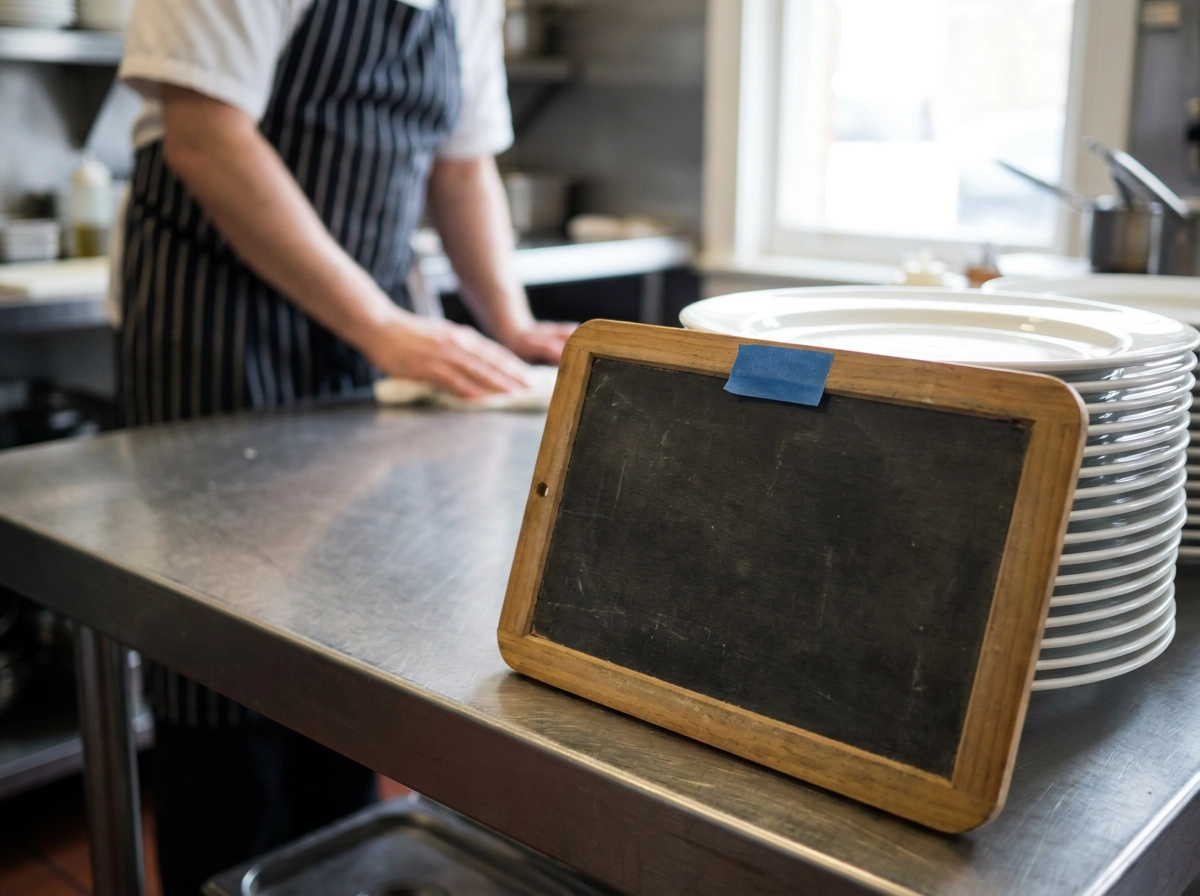
The physical tool that emerged from this need is the 86 board, traditionally a whiteboard or chalkboard positioned near the pass. As items run out during service, BOH staff mark them there, creating a running record of what's no longer available. It's a simple system, built for speed in a high-pressure environment, and it has been the default communication method in professional kitchens for decades.
The term's precise origins remain disputed among food historians, but its operational meaning in hospitality is unambiguous and universal. From there, "86'd" spread into broader restaurant lingo as shorthand for anything removed from the picture: a difficult customer asked to leave, a vendor contract canceled, a menu item quietly retired.
Operationally, the 86 restaurant term covers two distinct things: the verbal call that removes an item from play, and the board that tracks those calls across a full service. Understanding why that distinction matters is the starting point for a deeper look at why shouting "86" doesn't reliably reach everyone who needs to hear it.
The kitchen-to-floor 86 gap is the real subject of this piece. The 86 board has always been treated as kitchen infrastructure. But every failure it produces lands on the floor.
The Board Lives in the Kitchen. The Problem Lives on the Floor.
The 86 board's information flow has always been pull-based, never push-based. From the kitchen's perspective, once the item is marked, the job is done. What happens next falls entirely on the floor: servers are expected to check the board before service, catch the verbal call-out during pre-shift, or piece it together through word of mouth mid-rush.
The expectation that servers will find the 86 board collapses fast on a Friday night. On a busy Friday floor, servers managing multiple tables simultaneously have no spare moment to walk back to the pass and scan a whiteboard between table visits. The floor is moving constantly, and the board is standing still.
The failure surfaces at the table. A server confidently recommends the halibut, the guest orders it, and the kitchen fires back that it was 86'd two hours ago. Now that guest is being asked to re-decide under pressure, in front of the rest of the table, while the server absorbs the awkward silence. The kitchen logged the item correctly. The system failed everything that came after.
The kitchen-versus-floor asymmetry matters here. The kitchen's problem ended the moment the item went on the board. The floor's problem began at that exact moment and compounded with every order taken in ignorance since. One action, two completely different consequences, and only one side of the operation feels the impact.
The 86 board asymmetry is a systems design failure, not a staffing one. The whiteboard was built to display information to people who were already standing in the kitchen. It was never designed to push an update to anyone on the floor. The same static-format problem that undermines a paper prep list in a live service environment applies here: the tool captures the information, but it cannot move it to where the decision is actually being made.
What Does a Single 86 Gap Actually Cost?
A single 86 gap costs floor time, check average, comps off the bill, guest trust, and server morale, and it compounds faster than most operators realize.
Start with floor time. Every loop a server makes back to the pass to confirm an unavailable item, then back to the table to re-take the order, then back to re-enter it, is time off the floor. Those minutes don't redistribute; they simply disappear from a shift that was already stretched.
The revenue leak runs deeper than lost time. When a guest learns their first choice is unavailable after ordering, ordering momentum breaks. Some of those tables will downgrade, skip the course, or shorten the meal. The check average drops on a table that walked in ready to spend.
Then come the comps. When a server or manager works to absorb the awkwardness of an 86 surprise, recovery often means something coming off the bill. That cost is real margin leaving the building. It never appears on the 86 board. It shows up later, quietly, on the P&L.
The trust damage is subtler but more durable. A guest who orders something unavailable won't immediately complain; they'll just stop trusting that server's recommendations. For the rest of the visit, every suggestion the server makes lands with a fraction less confidence. Upsell effectiveness drops for the entire table, not just the one course.
Finally, there is the morale toll. The hospitality sector already averages 65.5% annual turnover, and research consistently links operational friction to disengagement. Returning to a table with bad news is one of the most demoralizing moments in service. When it happens because of a system failure rather than a personal oversight, servers feel the frustration without any sense of control over it. That feeling, repeated across enough shifts, is a resignation waiting to happen.
Why Are Manual 86 Boards Structurally Set Up to Lag?
Manual 86 boards lag because they are passive, updated late, limited to pre-shift call-outs, and never confirm that the message was received. Those costs are real. But before asking how to close the gap, it's worth examining why the gap exists in the first place. The manual 86 board doesn't fail because of inattentive staff. It fails because it was never engineered to do what restaurants now need it to do.
The board is passive by design. A whiteboard or chalkboard mounted near the pass is stationary, readable only at close range, and entirely dependent on servers choosing to check it. Information doesn't travel from the board to the floor; it sits and waits. In a service environment where a server is managing four tables simultaneously, walking back to the kitchen to consult a board isn't laziness, it's genuinely not an option.
The update itself is delayed. The line cook who just fired the last portion of the branzino is not stepping away from a hot line during a dinner rush to update a whiteboard. That task gets deferred to the next available moment, which could be two minutes later or ten. In the meantime, every server on the floor is working from a version of reality that's already out of date. As research into kitchen communication dynamics confirms, high noise levels and intense service pressure compound exactly these kinds of information transfer failures.
Pre-shift verbal call-outs cover only what's known before service starts. Any item that sells out at 7:45 p.m. on a Friday is completely outside that system. There's no broadcast mechanism, just the hope that someone tells someone.
Nothing confirms the message was received. A server who never saw the board update has no idea they missed it. Neither does the manager. The gap is invisible right up until it becomes a guest problem at the table.
Passive display, delayed updates, pre-shift-only call-outs, and missing confirmation are structural failure modes baked into the manual 86 board. A system that requires changing it once so the whole line sees it isn't a luxury feature; it's the correction to a design that was always one step behind real service conditions.
What Do Real-Time 86 Board Updates Change for Front of House?
Real-time 86 updates put every call on each server's phone the moment it happens, so the floor recommends with certainty instead of hunting for information. Fix the architecture, and the floor changes immediately.
When a digital 86 board pushes an update the moment a line cook marks an item out, that notification lands on every server's phone without anyone leaving a table, interrupting a conversation, or making a trip to the pass. The information finds the floor; the floor no longer hunts for the information.
Push-based 86 updates do something concrete to server behavior. A server carrying a live 86 feed doesn't hedge. They don't quietly hope the kitchen still has the halibut special while walking toward a table. They recommend with certainty, pivot to higher-margin alternatives without hesitation, and upsell without the background anxiety that the item might not exist. Confidence in a recommendation is directly tied to trust in the information behind it.
The confirmation layer compounds the benefit of push-based 86 updates. Digital 86 board systems that require FOH acknowledgment transform an invisible handoff into a documented one. There is no longer a plausible gap between "the kitchen marked it" and "the floor knew it." Every call is on record. That accountability closes the blindspot that manual boards structurally cannot address.
For the floor manager, the benefit extends further. A live availability view means no walk to the pass to verify what's left before reassigning a table or adjusting a recommendation on the fly. Potential comp situations become visible earlier, before a guest has already ordered and been disappointed, which is where recovery actually has leverage.
Heard is built around exactly this model. Its digital 86 board pushes live updates to every team member's phone during service, and every call requires confirmation rather than assumption. The same communication discipline that prevents 86 failures on a single floor also becomes critical infrastructure as complexity grows.
The 86 Board Is a Front of House Tool. Treat It Like One.
The kitchen owns the 86 board because the kitchen is where items run out. That logic is sound as far as it goes, but it stops at the pass. The servers carrying those menus to guests, and the guests making decisions based on them, bear every consequence of the board's accuracy. Origin of information and ownership of that information are not the same thing, and conflating them is where the system breaks down.
The 86 board should function as a shared communication channel, jointly maintained by BOH and FOH, not a kitchen bulletin board the floor consults when proximity allows. Shared ownership means shared accountability: the kitchen marks the item, and the floor confirms receipt. Without both halves, the channel is incomplete regardless of how accurately the kitchen side is managed.
What makes this the single fastest operational lever a restaurant can pull is its scope. Closing the 86 communication gap requires no menu overhaul, no additional hire, no physical renovation. The infrastructure problem is informational, and informational problems have informational solutions. Most other mid-service improvements involve tradeoffs; this one does not.
The competitive stakes make the problem harder to dismiss as minor. A single avoidable 86 failure at the wrong table, handled poorly, can produce a public record that outlasts the service by months. The operational cause is a missed update. The reputational cost is disproportionate to that simplicity, which is precisely why it warrants a systems-level response.
A real-time digital 86 board is not an amenity for well-resourced operations. For any restaurant that holds guest experience as a genuine standard rather than a stated value, it is the baseline infrastructure the commitment requires.
Close the Gap Before the Guest Notices It
The argument runs in one direction: a gap in your 86 board communication originates in the kitchen and terminates at a guest's table, costing you a re-order, a comp, a recommendation the server never gets to make, and trust that does not fully recover by the time the check arrives. None of that is inevitable. It is the predictable output of an information system that was never designed to push updates to the people who need them most.
Three actions close the gap.
First, audit your current flow. Map exactly how an 86 update travels from the cook who calls it to the last server on the floor. Identify where the handoff is verbal, where it is visual, and where it depends entirely on someone being in the right place at the right time. That is where your lag lives.
Second, make the 86 board a shared responsibility. If kitchen staff mark it and floor staff are merely invited to check it, the accountability structure guarantees blind spots. Shared ownership, whether through a more disciplined verbal protocol or a formal digital system, closes that gap by design rather than by luck.
Third, evaluate real-time tools built for this. Heard's digital 86 board provides live updates and confirmed receipt, as described in the front-of-house section. The information gap closes at its source, before a server recommends something the kitchen ran out of an hour ago.
The fix does not require a redesign. It requires treating the 86 board as what it always was: a guest experience tool that happens to live in the kitchen.
Conclusion
The 86 board was never just a kitchen tool. It is a live document that shapes every guest interaction happening on the floor at that moment. When updates lag, servers lose credibility, tables lose trust, and revenue leaks through corrections and comps that should never have happened.
The fix is informational, not structural, and the tools to close it exist now.
Start today by mapping your current update flow and finding exactly where the handoff breaks down. Then build a system designed to close that gap by default, not by luck.
The kitchen runs the food. The floor runs the experience. The 86 board connects both. Treat it accordingly, and your guests will never know the difference.
Sources
- “eighty-six” — definition and origin
Dictionary.com
Dictionary entry: first recorded 1930–35 as bar and restaurant slang, origin uncertain.
- 2026 State of the Restaurant Industry
National Restaurant Association
Annual operator survey on costs, traffic, profitability and technology adoption.
- Table 14-10-0406-01: Job vacancies, payroll employees, and job vacancy rate by industry sector, monthly
Statistics Canada
Monthly vacancy data by sector, including accommodation and food services.