What Roux Can Tell You About Last Saturday's Service (That No One Wrote Down)
Kitchen managers repeat the same weekly decisions without records to learn from. Here's how queryable operational data breaks that cycle for good.
Logan Manuel13 min read

Roux can tell you what ran short last Saturday, when, and whether it has happened before, because it answers from your kitchen's own prep history, 86 patterns and recipe usage. That record usually walks out the door with the manager on Sunday night; Roux keeps it queryable, so next week's decisions don't start from zero.
Someone in your kitchen knew exactly why last Saturday's service fell apart. They knew which prep items ran short by 6pm, which recipe got pulled twice in the same week, and why the 86 board told a story that had repeated itself three Fridays in a row. Then Sunday night came, and that knowledge walked out the door with them.
Losing service knowledge every Sunday night is the quiet operational crisis most kitchens never name. Your kitchen prep list app logs the data. Your team generates signals every single service. But without a system that retains, connects, and surfaces those patterns, every weekly decision starts from zero. Again.
The sections below examine what becomes possible when accumulated kitchen data stops being archived and starts being queryable. You will learn how prep histories, 86 patterns, and recipe usage data already contain the institutional memory your operation is missing, why that memory disappears without the right infrastructure, and what changes when an AI layer trained on your own kitchen's history can finally answer the questions you have been making judgment calls on for years. The record you wish you had last week is closer than you think.
The Knowledge That Walks Out the Door Every Sunday Night
Every Saturday night, a kitchen manager walks out the door carrying something that never made it onto any checklist: which proteins moved faster than expected, which station fell behind at the 7 p.m. turn, where prep ran short and why. That knowledge is real, hard-won, and completely unrecorded in any retrievable form.
When that manager rotates to another shift, transfers to a second location, or leaves the company entirely, everything they learned leaves with them. The next person inherits the same kitchen and makes the same mistakes, because there is no structural record of what those mistakes were or what caused them. They are not failing; they are starting from zero because the system gave them nothing else to start from.
The hospitality industry built itself on this model: experienced people holding institutional knowledge in their heads, passing it forward through proximity and tenure. That model breaks under modern conditions. With annual turnover in accommodation and food services averaging 75.6% since 2001, tenure is short and proximity is unreliable. At multiple locations, informal knowledge transfer becomes structurally impossible.
The result is compounding inefficiency. The same bad prep calls recur. The same 86 surprises hit mid-service. The same timing mistakes repeat, week after week, because no mechanism exists to catch the pattern.
Repeated prep and 86 mistakes are not a people problem. The managers are not careless and the cooks are not negligent. It is a systems problem, and that distinction matters because blaming people produces accountability measures that change nothing, while identifying a systems gap produces something that can actually be fixed.
The Data Is Already There, It Just Can't Answer Questions
Your kitchen already produces the raw material for closing that systems gap, every single shift. Every service generates real operational data, and that data survives in a form that cannot be questioned later.
Retrieval is the actual gap. Not a shortage of data, but a shortage of retrievable data. The notebook on the pass, the WhatsApp thread at 11 p.m., the dry-erase board someone photographed and never filed anywhere meaningful, these capture information in the moment and lose it by Tuesday. You can't query a photograph. You can't compare this Friday's notebook entry to last Friday's when neither is indexed or searchable.
A kitchen prep list app that replaces static paper formats does more than improve communication during service. Each logged prep session becomes a structured record, comparable against previous shifts, accessible to anyone on the team, and buildable over time into something genuinely teachable.
Recipe management software for restaurants adds another layer when it logs actual usage against planned quantities. That comparison is a gap map: which items were consistently over-prepped, which days showed recurring strain, where the spec and the reality have never actually aligned.
Building a queryable kitchen history requires no new information. It requires the information that already exists to be captured somewhere it can come back and answer a question.
What Does a Queryable Kitchen History Actually Look Like?
A queryable kitchen history turns a gut-feel prep call into a specific question answered in seconds from logged data. A manager walks into Tuesday prep trying to decide how much fish to pull. Without records, the call is a gut feeling shaped by vague memory. With a queryable prep history, it becomes a specific question: what did the last three Saturdays look like for fish, and did we run short? That question gets answered in seconds, not by recalling a conversation from two weeks ago, but by retrieving the actual logged data.
The value of that history is not static. Within a few months, logged prep lists begin reducing guesswork on comparable service days. Over time, weekly and volume-driven patterns emerge. A full season of records starts functioning as a decision engine, one a new hire can access from day one rather than spending months absorbing institutional knowledge that may not transfer accurately through conversation alone.
Source transparency is what separates useful pattern retrieval from black-box suggestion. The AI layer should surface the specific prep log entries, 86 records, or recipe usage figures behind any pattern it identifies, so the manager can interrogate the reasoning and override it where context is missing. Managers can review exactly which logged records, prep entries, 86 timestamps, recipe pulls, produced any given pattern flag.
The distinction that matters for kitchen AI: a tool that informs judgment rather than replaces it. The manager still makes the call. They are simply making it with access to what actually happened instead of what they think they remember.
In a prep kitchen running multiple sections, the benefit extends beyond planning. When different section leads can pull the same historical context independently, coordination stops depending on a single manager to relay information before service begins.
The 86 Board as an Early Warning System You've Never Used That Way
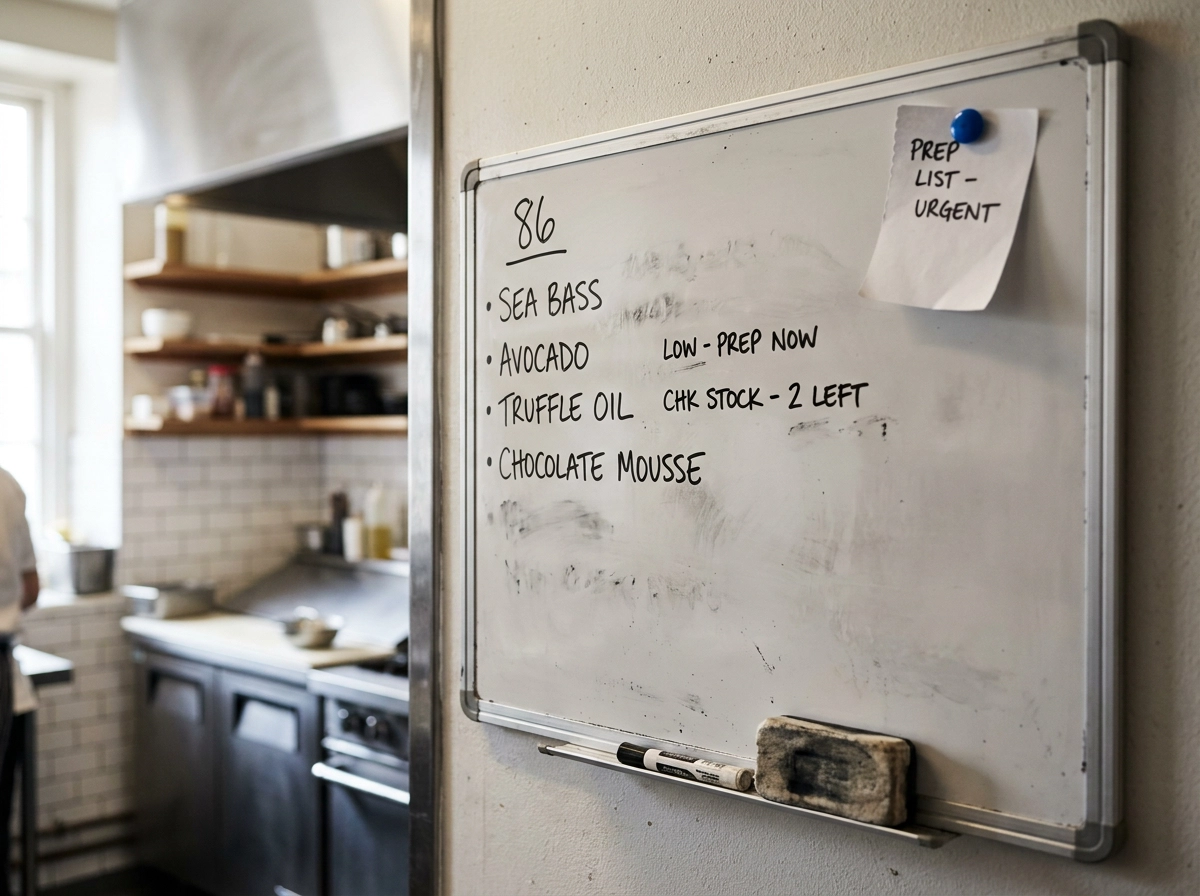
The Tuesday fish-prep example focuses on quantities. The 86 board tracks something different and, in some ways, more revealing: where your kitchen broke under real demand conditions.
Most operations treat the 86 board as a reactive communication tool. An item runs out, the board gets updated, the call goes out across the line, service continues. What almost never happens is any analysis of the record those boards collectively represent.
The 86 board record contains some of the most reliable signals in a kitchen's data. If the halibut goes 86 three out of four Friday nights, that's not bad luck. It's a prep quantity problem, a supplier reliability problem, or a demand estimation problem that has been repeating invisibly because no one examined the sequence. Each individual 86 felt like a one-off; the pattern only becomes visible when the instances are stored somewhere they can be compared.
Logged 86 data cross-referenced against day of week, cover count, and season gives managers a predictive lens that most operations have never had the data infrastructure to build. That predictive lens only exists if the data was captured cleanly in the first place.
Clean capture is where digital, live 86 boards matter beyond real-time communication. When an item is updated instantly and confirmed by the team rather than chalked up and missed, the resulting record is timestamped, attributed, and accurate enough to be analytically useful after the fact, not just during service.
For multi-location groups, the leverage compounds. Aggregated 86 patterns across sites reveal whether a recurring stockout is unique to one kitchen's prep process or reflects a supplier issue affecting every location. That cross-site diagnostic currently requires someone to manually compare notes that probably weren't kept.
Why Is Recipe Usage Data the Most Underused Operational Signal in Most Kitchens?
Recipe usage data is underused because it records what the kitchen actually did versus what it was told to do, and almost no one reads it that way. The 86 board captures what ran out; recipe data captures that subtler gap.
Most recipe management software for restaurants gets positioned as a consistency tool, a way to ensure the same plate leaves every station regardless of who's cooking. That's legitimate value. It's also the least interesting thing the data can do.
When recipe usage is logged across services, patterns emerge that no single shift would reveal. Certain dishes drive disproportionate recipe pulls on Friday and Saturday nights. Modifications cluster around the same items. Mid-service adjustments recur on the same days, never making it back into the original prep spec.
Deviations are where the real signal lives. A line cook who consistently scales a sauce quantity up on Fridays isn't improvising carelessly; they've learned something about Friday volume that the prep list hasn't caught up to yet. That adjustment represents genuine operational knowledge. Right now, it exists only in that cook's muscle memory and disappears the shift they leave.
Recipe management software that logs deviation patterns converts that informal knowledge into a structured asset the whole team can access. The cook's Friday adjustment becomes a documented pattern; the prep spec gets updated with evidence rather than instinct.
Cross-referencing recipe usage data with 86 logs and prep completion records produces something most kitchens never have: a three-signal view of any given service period. What was prepped, what got pulled and when, what the recipes actually required. Together, that's as close to a genuine post-service debrief as most operations will ever get.
Institutional Memory Is Infrastructure, Not a Nice-to-Have
The combined prep, 86, and recipe signal has real value, but only if it survives long enough to be used.
The National Restaurant Association's 2026 industry research identifies data analytics and technology adoption as central to how operators will manage cost pressure going forward, with food and labour costs rising sharply in recent years. Running on instinct alone is no longer a stylistic choice; it is a structural liability.
For multi-location groups, the cost is doubled: each kitchen independently re-solves problems the network has already paid to solve once. The NRA research makes clear that operators are under pressure to extract more intelligence from the data they already hold.
The onboarding argument is equally direct. A new kitchen manager handed a living operational history of how this specific kitchen has actually run, including its anomalies and recurring pressure points, gets up to speed faster than one handed a binder of SOPs that describes how it was supposed to run. SOPs capture intent. Logged prep lists, 86 records, and recipe usage capture reality.
Data-driven kitchen management is becoming a baseline expectation. Kitchens that begin building structured operational history today, even modestly, will have a fundamentally different decision-support environment in twelve months. The ones that wait start the clock later. The gap compounds either way.
What Changes When an AI Layer Actually Knows Your Kitchen?
When an AI layer knows your kitchen, prep decisions start from your own history instead of a blank slate or a generic benchmark. That accumulated history only matters if something can actually read it. Roux, Heard's AI layer, is what changes the operational picture.
The distinction that matters most: Roux is trained on a specific kitchen's own prep logs, 86 history, and recipe usage, not on generalised industry benchmarks. Generic benchmarks describe how restaurants are supposed to run. Roux describes how this kitchen actually runs, on this day of week, at this volume, with this menu. The pattern recognition is specific because the data is specific.
When Roux flags a prep quantity, it shows its work. The manager can see the actual records behind the observation: which Saturdays, which 86 entries, which recipe pulls produced that signal. That transparency matters because Roux doesn't have every piece of context a manager holds. The recommendation can be interrogated, adjusted, or overridden. That is not a weakness in the tool; it is the point of it.
The data quality feeding Roux is also worth noting. Because Heard already functions as a kitchen prep list app with live updates confirmed by the team during service, the records are timestamped and verified, not reconstructed from memory two days later. Clean inputs produce meaningful patterns. Reconstructed inputs produce noise.
With Roux, a kitchen manager's Tuesday prep starts with a prompt, not a blank slate. The call is still the manager's.
Roux is not kitchen automation. It is institutional memory made accessible: a tool experienced managers use to move faster, and a resource new managers use to get up to speed without the slow accumulation of hard lessons.
The Record You Wish You Had Last Week
The practical question isn't whether to start; it's whether you can afford another twelve months of the same blind calls.
Start capturing operational data now, in whatever format your team will actually use. Imperfect records stored somewhere retrievable compound in value faster than perfect records that exist only in someone's memory. A logged prep list from six months ago, even incomplete, is worth more than a flawless mental reconstruction that leaves with the manager who held it.
Treat the 86 board and your prep list as data sources first, communication tools second. Sequence requires storage, and storage requires a system rather than a whiteboard.
When evaluating recipe management software for your restaurant, look specifically for whether it logs actual usage against target quantities. The deviation between the two is where the most actionable intelligence sits.
When evaluating any AI kitchen tool, two questions decide its value: is it trained on your kitchen's history, and does it cite its sources?
The goal of kitchen data is not automation. The goal is a kitchen where operational knowledge survives staff changes, accelerates onboarding, and compounds into a genuine competitive advantage over time.
Conclusion
Your kitchen already generates the data it needs to run better. The problem is not a lack of information; it is a lack of systems that store, sequence, and surface that information when decisions have to be made.
The knowledge your kitchen generates every service is either infrastructure or exhaust, the only variable is whether you store it. Start one week of prep actuals against targets; the compounding begins there.
The kitchens that compound knowledge over time will outrun the ones that start from scratch every Sunday night.
Sources
- 2026 State of the Restaurant Industry
National Restaurant Association
Annual operator survey on costs, traffic, profitability and technology adoption.
- Workforce challenges are growing and here’s how we’re responding
Restaurants Canada
CEO note, January 2026, on the structural labour shortage in Canadian foodservice.
- Table 14-10-0406-01: Job vacancies, payroll employees, and job vacancy rate by industry sector, monthly
Statistics Canada
Monthly vacancy data by sector, including accommodation and food services.