How Roux Turns Kitchen Data Into Line-Ready Answers
Roux answers the line's questions from your kitchen's own recipes, prep history and operational records, not from generic AI. A cook asks about a par level or a prep sequence and gets an answer drawn from what your team has already done, with the source to check it, instead of waiting for the one person who knows.

Every kitchen runs on institutional knowledge. The Friday par that took six months to dial in. The prep sequence your best cook figured out the hard way. The line setup from that insane Saturday in March. That knowledge exists somewhere, but too often it lives in one person's head, scribbled on a sticky note, or buried in a folder nobody opens anymore.
When the one person holding a kitchen's institutional knowledge is not on the floor, the questions pile up. And in 2025, with 45% of restaurant operators reporting unprofitability and food costs up 38% since 2019, there is no room for operational friction. Every repeated question, every guessed par level, every onboarding fumble costs you something you cannot afford to give away.
Roux, Heard's AI layer, was built to solve the knowledge-bottleneck problem. As a kitchen prep list app with an AI layer trained on your actual recipes and prep history, Roux turns the knowledge your team has already built into answers anyone on the line can pull up and trust. The sections below cover how Roux works in practice, what data it draws from, and how to build a kitchen that genuinely gets smarter with every single shift.
Why Operational Efficiency Can't Wait for the Industry Right Now
Nearly half of restaurant operators ran unprofitable businesses in 2025. That is not a warning about where the industry is headed; it is the current baseline according to the National Restaurant Association's 2026 State of the Restaurant Industry report. If your kitchen is profitable right now, you are already in the minority.
The cost structure behind the 45% unprofitability figure has been building for years. Food costs are up 38% since 2019 and labor costs up 35% over the same period. Those increases do not compress back down. They permanently shrink the margin cushion that once allowed kitchens to absorb a sloppy prep sequence, an over-ordered protein, or redundant manager questions without feeling it on the bottom line.
Revenue growth is not a reliable offset to rising food and labor costs. Six in ten operators experienced traffic declines in 2025. Consumer spending is tightening, particularly among middle- and lower-income households that make up a significant share of restaurant traffic. For most kitchens, waiting for covers to recover is not a strategy. The only lever genuinely within reach is how tightly the operation runs.
The National Restaurant Association is direct about the response: data analytics and technology are critical to industry success in 2026. Kitchen operations are moving from intuition-driven to data-informed, and the gap between kitchens that make that shift and those that don't will show up in the numbers.
Margin pressure comes down to a specific, unglamorous kitchen problem. Every time a manager stops mid-prep to answer "what's the par for tonight?" or "how do we sequence the fish station?", focused attention is spent on a question that already has an answer somewhere in the kitchen's history. Multiply that across a week and you are looking at a meaningful drain on the scarcest resource in any kitchen, including kitchens already dealing with communication breakdowns that happen when 86 calls don't reach every station reliably. The margins do not forgive compounding inefficiency anymore.
Why Can't Generic AI Answer a Kitchen's Real Questions?
Generic AI can't answer a kitchen's real questions because it has never seen your prep lists, recipes, or service history. Tightening operational efficiency is only half the equation. The other half is making sure your team can access the right information without burning a manager's time every time a question comes up. That is where generic AI hits a hard wall.
Ask a general-purpose AI tool what your Friday fish par should be, and it will give you a confident, well-formatted answer based on industry averages and generic prep guidance. What it cannot tell you is that your kitchen runs 30% heavier on the fish special the first Friday of every month, or that your prep sequence for that station starts with the sauce reduction, not the protein breakdown. It has never seen your prep lists. It does not know your service patterns exist.
The problem is not what generic AI knows. It is what it has never seen.
Kitchen-specific operational questions require kitchen-specific history. What's the par for Friday service? What did last week's line call look like? What is the correct prep sequence for the grill station during a high-cover night? None of those answers live in public training data. They live in your kitchen's accumulated records, and if those records are not digitized and queryable, they live in one manager's head.
Knowledge locked in one manager's head is the real bottleneck. Experienced managers carry enormous operational knowledge, and when they leave, that knowledge walks out with them. The same questions get asked and re-answered, shift after shift. As noted in how a kitchen prep list template becomes a liability after your third location, once operational complexity grows, knowledge locked in one format or one person's memory stops scaling.
Restaurant technology has largely solved for the front of house: digital ordering, reservation systems, table management. Back-of-house operational intelligence has lagged significantly behind. No amount of general training fills a context gap. Only your actual prep lists, recipe book, and service history can do that.
What Data Does Roux Actually Work From in Your Kitchen?
Roux works from the data your kitchen has already built inside Heard: your digitized prep lists, the live 86 board, and the recipe book. These aren't separate reference files sitting in a folder somewhere. They're the same records your team works from every shift, now queryable.
The prep list is where Roux gets powerful over time. Every time a prep list gets completed, modified, or flagged inside Heard, that record accumulates. Roux draws on that history when answering operational questions, so the answer reflects what your kitchen has actually done across comparable services, not what some average kitchen might do. That distinction matters when you're trying to set a Friday fish par or figure out how a specific station ran during a high-cover Saturday.
The recipe book inside Heard feeds Roux the same way. It isn't just a static reference document your team ignores after week one. It becomes the source layer Roux cites when a new hire asks about a prep sequence or a manager needs to confirm a portion spec mid-service without interrupting someone. If you've ever wished you could fix the communication failures your paper prep list creates, having that recipe data digitized and centralized is the prerequisite.
The 86 board adds a third layer: real-time context. Roux can surface answers that account for what's actually available right now, not just what was theoretically prepped at the start of the shift.
Queryable history is why kitchen prep list app functionality matters beyond simple task tracking. When prep data is digitized and centralized, it stops being a checklist that gets tossed at end of shift. It becomes the operational foundation Roux builds answers from, compounding in value with every service your team runs.
How Does Roux Surface Answers the Line Can Actually Trust?
Roux cites the specific prep records behind every answer, so anyone on the line can check it rather than take it on faith. Having that data in a queryable form is only half the equation. The other half is whether your team will actually trust what comes back.
Source citations are how Roux earns the line's trust. When a line cook asks about the Friday fish par, Roux doesn't just return a number. It points to the specific prep records that informed the answer, so anyone on the team can verify the logic rather than take it on faith. That's not a minor UX detail; it's the whole trust model.
In a kitchen, a wrong answer has real consequences. A new hire who misreads a prep quantity doesn't discover the problem in a feedback session. The problem shows up at 7pm, mid-service, when the station runs short. Trust in this environment has to be earned operationally, not assumed.
Think about how a veteran manager actually builds credibility with a new team. They don't just say "do 40 portions." They say "we ran 38 last Saturday and 41 the Saturday before, and the standing fish order covers 45." That's the Roux (AI) model exactly: an answer plus the sourced reasoning behind it.
For catering management and high-volume prep, a cited answer removes a real bottleneck. When team members can confirm a par or sequence against cited records, they don't have to queue up for a manager who's already juggling three other things during the pre-service window.
Generic AI cannot cite a kitchen's own records. It returns confident-sounding answers built from general training data, with no traceable source and no connection to your kitchen's actual history. A seasoned kitchen team will distrust that output correctly, because the stakes are too high to act on an answer nobody can verify.
What This Looks Like During an Actual Service
Three service scenarios show what Roux's source-citation trust mechanism looks like when it hits the floor.
Scenario 1: Par Forecasting on a Friday
At 10 a.m. on a Friday, the prep cook needs to know how much fish to break down before the rush. The manager is in the office dealing with a vendor. Instead of hunting them down, the cook queries Roux, which pulls from the last several Friday prep lists logged in Heard. The answer comes back with the specific records cited, so the cook can see exactly which Fridays informed it. No guesswork, no delay, no interruption.
Scenario 2: Onboarding a New Hire
A new team member needs to learn the prep sequence for their station. Traditionally, that means shadowing a senior cook for most of a shift, pulling that cook's attention away from their own work. With Roux, the new hire queries the prep list and recipe data directly and gets a step-by-step sequence drawn from how the kitchen has actually run that station, with sources attached. The senior cook stays focused. The new hire gets up to speed faster, grounded in real kitchen prep history rather than one person's verbal walkthrough.
Scenario 3: Reconstructing a High-Cover Saturday
A manager is planning a private event and needs to know how the team handled a similar high-cover Saturday six weeks ago. That knowledge used to live in someone's memory or a notebook no one can find. Roux surfaces the relevant prep list records directly, giving the manager a documented baseline to build from rather than a best guess.
In all three scenarios, the kitchen's own accumulated data is doing the work. Roux makes that data answerable rather than just archived, and the team's operational knowledge stays accessible regardless of who we share it with or who happens to be in the building.
How Do You Build a Kitchen That Gets Smarter With Every Shift?
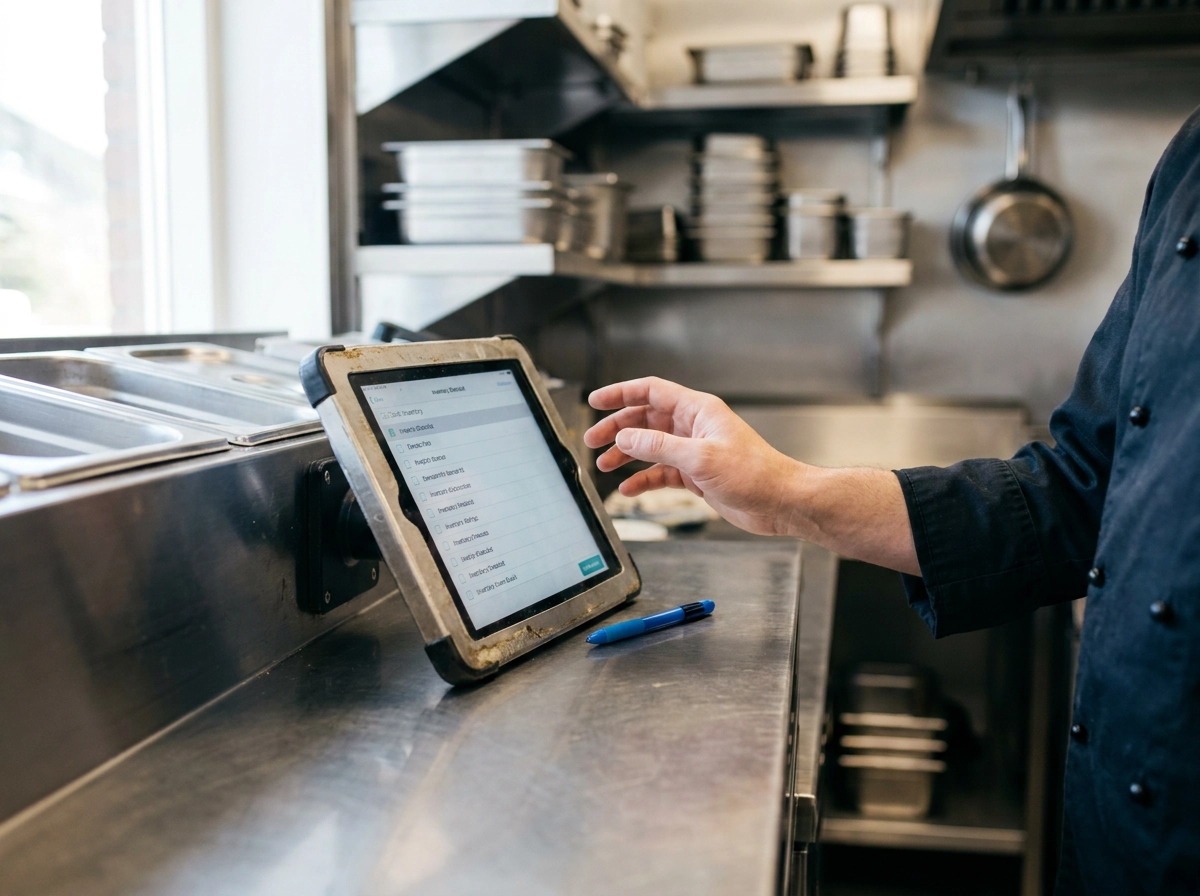
A kitchen gets smarter with every shift by centralizing its prep list, recipe book, and 86 board in one system and logging to it consistently, shift after shift. The par-forecasting, onboarding, and event-planning scenarios all share a common thread: the kitchen's own data did the heavy lifting. The question is how to make sure that data keeps accumulating in a form Roux can actually use.
Here is the practical path to a kitchen that gets smarter with every shift.
Start by centralizing the basics. Roux needs structured, queryable data to work from, which means the data has to exist somewhere before it can be indexed. Centralizing your prep list, recipe book, and 86 board inside a kitchen prep list app like Heard is the prerequisite step, not the finish line. Once those records live in one place and update in real time, every shift your team works is building the operational foundation Roux draws from.
Consistency beats perfection. A kitchen that logs prep data reliably but imperfectly for three months builds a more useful record than one that sets up a flawless system, burns out maintaining it, and abandons it by week four. Incomplete entries are fine. Gaps are fine. What matters is the habit of logging, because a consistent but imperfect record compounds into something genuinely useful. A perfect record that stops after two weeks does not.
For catering management teams, there is one additional discipline worth building early: tag prep records by event format and cover count. When every event looks the same to the system, Roux averages across dissimilar services and the comparisons lose precision. Tagged records let Roux scale the menu to the room and surface the right historical reference for a 200-person plated dinner versus a 60-person cocktail reception.
On workforce development: new hires who can query operational history get up to speed faster and pull fewer answers from experienced staff. With labor costs up 35% since 2019, reducing that onboarding drag has real dollar value.
The Takeaway: Your Kitchen Already Has the Answers
Every shift your kitchen runs is generating operational knowledge. The only question is whether that knowledge gets captured in a form the whole team can use, or whether it stays in one manager's head until they're off the floor.
Roux doesn't replace what your experienced cooks and managers know. It makes that expertise available to everyone on the team, at any point during service, without requiring the expert to be standing next to them.
Source citation matters more than it might seem. A line cook who gets a confident-sounding answer with no traceable source will do exactly what any seasoned kitchen person should do: ignore it. Cited, kitchen-native answers aren't a nice-to-have feature. They are the specific condition under which a line team will actually act on what Roux surfaces. Generic AI can't meet that bar. Your own prep history can.
Here's where to start:
Digitize your prep list and recipe book inside Heard. The data layer has to exist before Roux can index it. This is the only prerequisite, and it's work your kitchen needs done anyway.
Run Heard consistently from the first shift forward. The value compounds immediately. Every completed prep list, every recipe entry, every update makes the next answer more grounded than the last.
Let Roux do the work from there. Once the data exists in a queryable form, Roux turns your kitchen's accumulated history into answers the team can verify and act on.
With 45% of operators unprofitable in 2025 and food and labor costs still climbing, the margin for relying on one person's recall is gone. The kitchens building queryable operational memory now are building a structural advantage that only grows over time.
Conclusion
Your kitchen is already generating the data it needs to run better. The gap isn't information; it's accessibility. Roux closes that gap by turning your prep history, recipes, and operational records into answers any team member can query and verify in real time.
The core takeaways are straightforward: generic AI cannot answer kitchen-specific questions with any reliability; your own operational data can. Trust requires citation, and citation requires data that lives inside your four walls. The kitchens that digitize now build an advantage that compounds with every single shift.
The starting point is simple. Get your prep lists and recipes into Heard. Run it consistently. Let the indexed history do the work from there.
Kitchen knowledge shouldn't depend on who is standing on the floor tonight. Build the system that makes it available every service, to every cook, regardless of who shows up.
Sources
- 2026 State of the Restaurant Industry
National Restaurant Association
Annual operator survey on costs, traffic, profitability and technology adoption.
- Table 14-10-0406-01: Job vacancies, payroll employees, and job vacancy rate by industry sector, monthly
Statistics Canada
Monthly vacancy data by sector, including accommodation and food services.
- Workforce challenges are growing and here’s how we’re responding
Restaurants Canada
CEO note, January 2026, on the structural labour shortage in Canadian foodservice.